

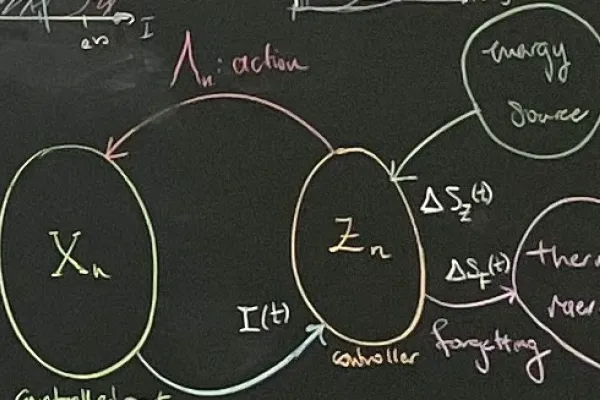
Understanding the universal mechanisms by which complex interactions give rise to emergent structures, states, and dynamics across scales. This includes the role of nonlinearity, feedback, fluctuations, and non-equilibrium conditions in shaping organized complexity in physical, biological, and engineered systems. By combining approaches from non-equilibrium statistical physics and nonlinear dynamics, we ask questions such as how a nonlinear and strongly stochastic system with access to multiple states selects among them, and why.
Fig.: Theoretical approaches to understanding and harnessing complex interactions are multidisciplinary, drawing on concepts and techniques from nonlinear and non-equilibrium statistical physics, control theory, and machine learning.